
 MyCLHA
 LPNs
LPNs
Working Within Scope of Practice
Information for Health Care Aides
As regulated professionals, Health Care Aides (HCAs) have a responsibility to practice within their scope of practice. This article will help HCAs and other interested parties understand how to meet this important requirement.
There are three main areas of HCA scope of practice that need to be considered:
- Regulatory scope of practice,
- Employer scope of practice, and
- Individual scope of practice.
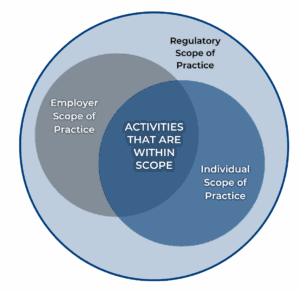
A task must fall within all three of the above areas for an HCA to be able to perform it.

Regulatory Scope of Practice: Laws, Regulations, Standards, and More
Laws and regulations broadly define what tasks HCAs are allowed to do. According to the Health Professions Act, HCAs can provide one or more of these professional services:
- Support activities of daily living to provide basic personal care and health services,
- Participate in client education and promotion of client wellness across the lifespan,
- Assist in teaching an approved HCA certificate program,
- Teach HCA techniques and practices to practitioners in the workplace, and
- Provide restricted activities identified by the regulations.
More guidance on HCA scope of practice is provided through standards of practice, code of ethics, and other resources. To learn more about regulatory scope of practice specifically, HCAs should start by reviewing the following documents.
- Health Professions Act, Schedule 10
- Health Professions Restricted Activity Regulation, Section 23.1
- Entry-Level Competencies for HCAs
- Standards of Practice for HCAs on Restricted Activities and Supervision
An example of determining regulatory scope of practice is below. Click the “+” symbol to view.
An HCA, Marisol, is assigned the task of administering a suppository to a client. She learns from page 18 of the Health Professions Act, 1.3(1)(b)(vi), that administering a suppository is a restricted activity as it involves inserting a finger beyond the anal verge.
A restricted activity is a high-risk health service that can only be performed by an authorized professional. The Health Professions Restricted Activity Regulation authorizes HCAs to perform the following restricted activity in 23.1(2), page 18:
To insert or remove instruments, devices, fingers, or hands beyond the:
- Labia Majora, or
- Anal verge.
This means that administering a suppository is in HCA regulatory scope of practice. Marisol accesses the Standards of Practice for HCAs on Restricted Activities and Supervision to understand the requirements she needs to meet as a regulated HCA with the CLHA to administer a suppository. The Standards of Practice state Marisol can perform the restricted activity if:
- The task is written in the client’s care plan;
- She has been assigned and provided with client-specific training by an authorized supervising health professional (e.g., a nurse);
- She has the competence, knowledge, skills, and abilities necessary to perform the activity safely;
- She has reviewed the client’s care plan and understands and follows any additional instructions provided; and
- She is performing the restricted activity under the supervision of an authorized health professional, such as a nurse.
After reviewing the relevant documents, Marisol determines that all requirements have been met. She performs the activity and documents the care provided as required by her employer.
Employer Scope of Practice: Policies, Job Descriptions, Care Plan, and More
HCA scope of practice can change depending on the practice setting. This is because employers can establish the HCA role in their setting, as long as any task assigned is within HCA regulatory scope of practice.
To learn about the scope of practice in a specific setting, HCAs may:
- Look at their employer policies and procedures,
- Review their own job description, or
- Talk to their supervisor, manager, or educator about which tasks they are allowed to perform in their practice setting.
An example of determining employer scope of practice is below. Click the “+” symbol to view.
An HCA, Jo, works at a Type B care home where she performs medication assistance. She helps clients who are unable to safely take their medications on their own. In Jo’s role, this includes reminding clients to take their medications and opening medication packages for clients.
Jo changes jobs and begins working at a hospital. At the hospital, her role does not include providing medication assistance.
She asks her supervisor whether she can help the healthcare team by performing medication assistance, since she has done so many times in the past. The supervisor explains that HCAs in the hospital do not perform medication assistance. This decision was made because these clients are generally of higher acuity, meaning that they have less predictable responses to medication. Jo’s new employer therefore determined that HCAs would not perform medication assistance in that specific setting.
Individual Scope of Practice: Knowledge, Skills, Abilities, and More
HCAs should only perform tasks that they have the competence to perform. Individual competence is having the knowledge, skills, abilities, judgment, and experience to perform a task safely.
An employer may require an HCA to perform activities that are within HCA regulatory scope of practice but that the HCA hasn’t been trained to do. In these cases, as long as the task falls under one of the professional services an HCA can perform, the HCA then needs to seek out training so that they can support their clients safely.
An example of determining individual scope of practice is below. Click the “+” symbol to view.
An HCA, Frank, works in home care. His supervisor, an LPN, assigns him a client who has tremors and cannot insert their medicated eye drops without assistance. Performing this task is part of medication assistance because the client is unable to safely use the eye drops on their own.
However, Frank has never helped with eye drops before. The LPN goes with Frank on his home visit, reviews the medication and care plan instructions, trains him on how to assist with inserting the eye drops, and watches him perform the task. The LPN explains what observations Frank should make after administering the eye drops, what should be reported to the supervisor, and what should be documented in the client’s chart. Frank communicates that he feels comfortable performing this task on his own. In the future, the LPN or another supervising health professional will be available by phone if Frank has questions or concerns.
In this example, physically assisting the client with their eye drops is in the HCA regulatory scope of practice because it is part of medication assistance. Frank knows that this task is in his employer’s scope of practice because he was assigned it by his supervisor. However, assisting with eye drops was not in Frank’s individual scope of practice, so he received client-specific training from the LPN to gain competence in performing this task.
Decision Making: Three Factor Framework
To evaluate their scope of practice, an HCA must consider their regulatory, employer, and individual scopes of practice. HCAs also need to consider the specific circumstances in which they are performing a task. This includes:
- The HCA’s competence, including their knowledge, skills, experience, education, and training.
- The client’s needs and preferences, including their risk factors.
- The environment in which a task is being performed, which includes equipment, if other professionals are available to help, policies and procedures, and availability of training.
An example of using the three-factor framework is below. Click the “+” symbol to view.
Lisa, an HCA working in long-term care, discovers that one of her elderly clients has fallen out of bed. She is the first health professional to find the client.
Lisa knows how to assist the client in getting back into bed, but she also knows that her facility has a policy of assessing any falls to ensure the client can be safely moved. As an HCA, performing assessments is not in Lisa’s regulatory scope of practice. Therefore, Lisa calls for her supervisor, an LPN.
The LPN assesses the client and determines that it is safe to move them. Lisa assists the client back into bed and documents the incident following her employer policy.
In this example, Lisa worked through the three-factor framework in the following ways:
- HCA competence: Lisa knows how to perform a lift assist, and this is part of her regulatory and employer scope of practice. However, performing an assessment is not in the HCA regulatory scope of practice.
- Client’s needs: The client needs assistance getting back into bed, but must be assessed for injury first.
- Environmental factors: The facility has a policy of assessing injuries in the event of a fall. An LPN was available for the assessment. Lisa followed employer requirements for documentation.
Putting It All Together: What Is HCA Scope of Practice?
Client safety should be at the centre of any decisions made about HCA scope of practice. Every task needs to be:
- authorized by laws and regulations (regulatory scope of practice),
- allowed by their employer (employer scope of practice), and
- a task that the HCA is competent to perform (individual scope of practice).
The graphic below shows how tasks that are a part of a specific HCA’s scope of practice must be in their regulatory, employer, and individual scopes of practice.
By answering the situation-specific questions in this tool, HCAs and others can determine if specific tasks are within HCA scope of practice.
This guideline explains an HCA’s responsibilities when accepting activity of daily living tasks assigned by a supervisor.
This guideline helps HCAs and others understand the factors that must be considered when determining whether a task falls within HCA scope of practice.